
Congratulations, that decision is the first big step to making it happen.
What next?
The first questions to ask are;
- What is the story you want to tell?
- Who are you telling this to?
- How are you going to tell it?
These notes and resources are here to help you plan your film and have it ready to enter into the Te Tai Tokerau climate action film contest.
All the best and make sure you have fun being creative!
Story
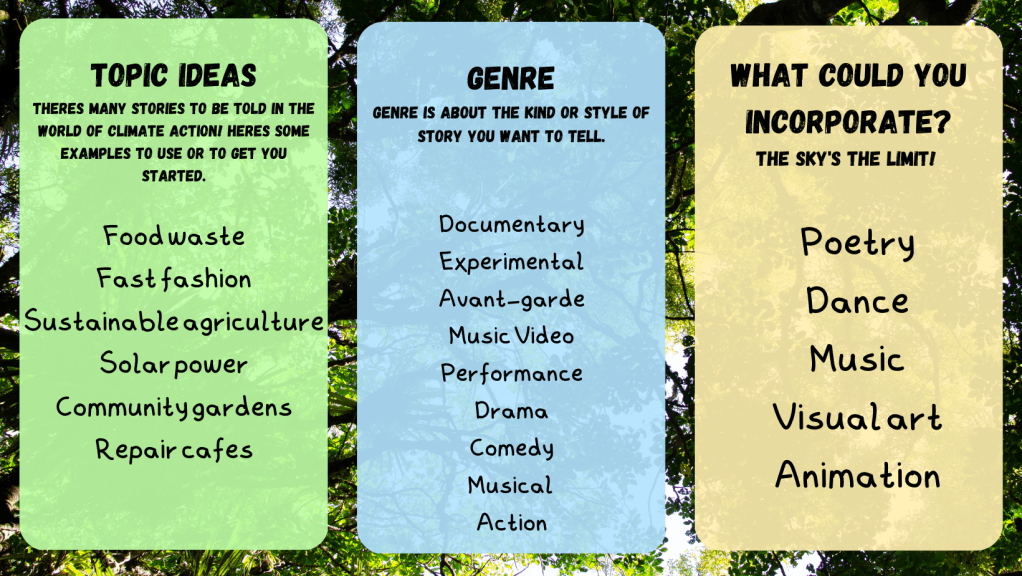
A good story has a beginning, middle and an end – even if its a documentary or music video.
Brainstorming the who, what, why, where and how is a great place to start.
Where is this going to be?
What is going to happen and when?
It helps to write your ideas down, or your lines of dialogue if you have any narrators, presentors or actors.
Research
When you’re telling a factual story, do your research so you know about your subject.
Know what your sources of information are, and check that they are accurate and reputable or well-known sources.
If you don’t know something, ask someone who knows the subject matter well – maybe interview them for your film! Check you have permission to tell a story if it belongs to someone else, and that you treat the subject and/or people involved respectfully.
Storyboard
A story-board helps you to imagine and plan what your completed film to look like. Do you want some wide landscape shots? Close-ups? How do you want to frame interviews? What types of shots and framing will you use to film action happening?
Your storyboard doesn’t need to be complicated or even 100% organised before filming. You can just use stick figures and rough drawings, as it’s just a guide for you to work out ideas and then follow during filming and editing.
Check out these links for more story board info –
https://filmlifestyle.com/best-movie-storyboard-ideas/
https://boords.com/how-to-storyboard/documentary
https://www.studiobinder.com/blog/how-to-create-a-documentary-storyboard/
Permissions and Consents
If you’re making a Documentary, the people you film need to give you their permission.
Locations that you may film at or of, need also to give permission before filming.
It’s best to get any permissions in written form. This makes it clear to the person or location owner what is involved and where the film will be shown. It makes sure everyone’s on the same page.
Likewise, do not film people without their consent. If they just appear in the background, this can often just be verbal consent, but a written one makes it more clear.
If you are filming in a public area, let people know what you are doing (verbally or with signs), and give them the option to not be in it if they do not want to be filmed. Here is the NZ law around filming in a public space.
At the bottom of this page are templates for a Personal Consent form and a Locations Consent form to use. Feel free to copy and adjust them as you need.
There’s also copyright laws about using other people’s films in your film, which is legal to an extent. It’s all to do with ‘Fair use’. Basically, you can use clips from somewhere else and not have to ask permission from the maker if; the use of the work is transformative, it’s a short clip, your film won’t be affecting the commercial side of the work and your film is using it in an educational way, rather than trying to profit. This guy explains it well, using Rick and Morty – https://www.youtube.com/watch?v=MSCSh7ZVtCc (the first 6 mins and 40 secs explains it all. The rest is more relevant to full-time youtubers.)
Music
Use of music in films has many restrictions for replaying, and ideally, you should use royalty free (fees free) music, music you have paid a fee to use or specially composed music you have made.
If want to use non-free music in your film (pretty much any top 40, radio played song) then you need to fill out a Music Cue sheet with Apra/Amcos, who are the fee collection agency for Aotearoa/New Zealand – https://www.apraamcos.co.nz/
There’s lots of royalty free music out there, where all you have to do is credit the artist. Check out this article – 10 Websites To Get Royalty Free Music For Short Films & Documentaries
Health and Safety
Always be aware of and take care of the Health and Safety of those you are filming with and around, yourself and your crew while you make your Film. Be careful with equipment, locations, vehicles etc. Check the weather forecasts before going somewhere outside to film all day.
Audience
Who are you designing this story for?
Remember you are making the Film for people to watch and enjoy.
Hopefully, this goes without saying – this competition has a G rating, suitable for a general audience, meaning anyone of any age group can watch. Read this or email us if you have any questions around this. Heres our email: events@northlandclimatechange.org
Film entries that break this G rating cannot be considered as part of the competition, as entries will need to be screened before G audiences.
Technical info
We ask that you hand in your completed film in an MP4 format. You can email the file to us at events@northlandclimatechange.org using a drop box/google drive link or email us to sort out a pick up/drop of a memory stick. Also email if you are having technical issues too of course!
Most smart phones or tablets these days will be more than enough quality to film on. It’s all about using what you have – don’t worry we aren’t expecting you to have high-tech fancy film cameras!
Heres some tips for filming on a phone – https://www.screenskills.com/your-career/lesson-plans-and-classroom-resources/top-tips-for-filming-with-a-phone/
Need some inspiration? Give these a google…
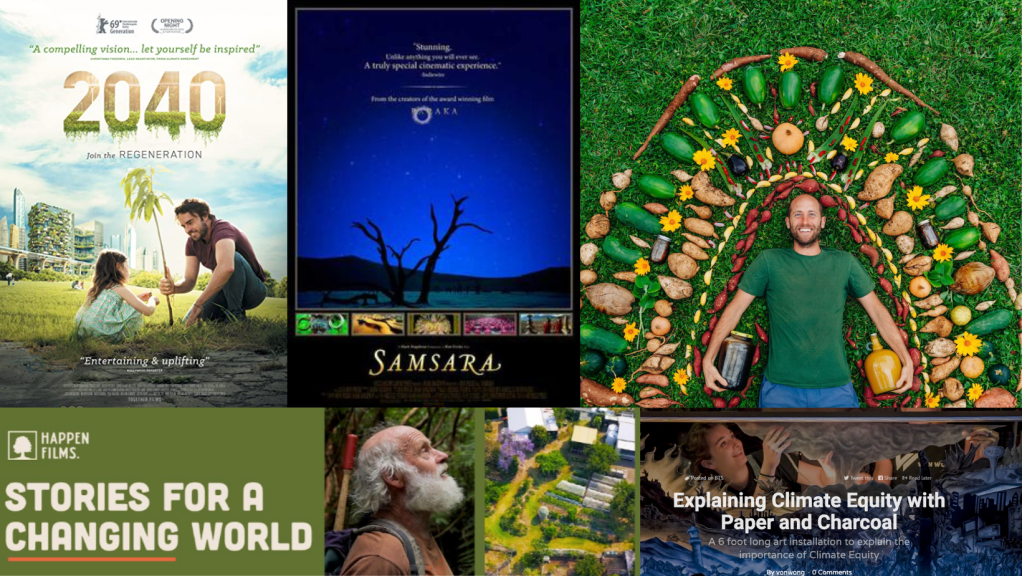
- “Baraka” and “Samsara” – Visually amazing documentaries directed by Ron Fricke about life on this earth.
- Waterbear is a free streaming website who says they are “the first interactive streaming platform dedicated to the future of our planet.” It’s full of documentaries. Check out “Youth Unstoppable.” https://join.waterbear.com/
- Bill Morris – a New Zealand documentary filmmaker, wildlife cameraman and science journalist. He has worked on things like BBC’s “Our Big Blue Backyard” and “Seven Worlds, One Planet”.
- “A Beautiful Lie” – 30 seconds to Mars music video about climate change
- “Bow down” – Xavier Rudd music video about climate change
- “Fallen Fruit” – a Lorde music video about climate change
- “2040” – documentary directed by Damon Gameau. Using a positive angle, it’s about what life on earth could be like in 2040 if we act now.
- “High Tide, Don’t Hide” – a documentary by The Rebel Film Collective. It’s about the NZ school strike movement. https://hightide-donthide.com/sample-page/
- “Explaining Climate Equity,” a really cool mix of video and illustration. https://blog.vonwong.com/climateequity/. The guy behind it, Von Wong, has some other amazing climate art on his main website – https://www.vonwong.com/ and more behind the scenes videos here – https://www.youtube.com/@Vonwong
- This is a really cool NZ channel that makes documentaries about sustainability – https://youtube.com/@happenfilms
- Rob Greenfield – this guy is all about saving our planet and has lots of interesting videos on his YouTube https://youtube.com/@RobGreenfield
- Check out this Northland based filmmaker – Harley Alexander:
- https://www.creativecavalry.com/
- And this one – Gines Pastor: https://ginespastor.wixsite.com/antipodesproductions
- Check out this USA based climate action film comp! Click on “Archives” in the top right hand corner to watch past entries – https://www.climateactionfilmfestival.com/
Helpful film-making resources and climate info:
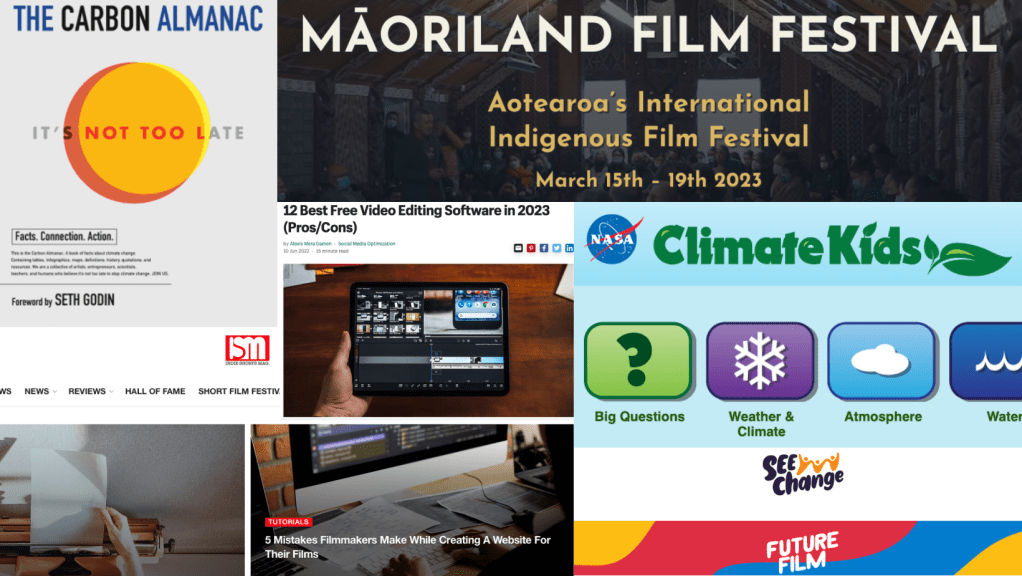
- https://seechange.org.au/futurefilm – another youth based climate change film competition. There’s a few helpful slide shows about film making down the bottom of this page.
- https://thecarbonalmanac.org/ – this website has lots of easy to understand info about carbon and climate change. It’s based on the book called “The Carbon Almanac”, which was written in 2022 by a whole heap of climate scientists. Check their easy to understand kids book (which taught me some stuff!) – https://thecarbonalmanac.org/wp-content/uploads/2022/06/GenC_ebook.pdf Or this ‘connect the dots’ page, where you can click on a topic and see what actions you can take to mitigate the climate harm. I typed in ‘art’ in the top left search bar, and got some interesting results! – https://publish.obsidian.md/carbon-dots/%E2%97%8F+Welcome
- Check out this awesome climate website that NASA made! It’s choca full of easy to understand climate science info. https://climatekids.nasa.gov/menu/dream/
- www.majorarc.org – An Aotearoa organisation who supports people in telling stories with the potential for positive social and environmental change.
- Have you heard of “Ethically Kate”? She’s an awesome kiwi on a mission to help us all become more sustainable. Heres her website https://ethicallykate.com/
- Heres some topic ideas – “9 things you can do about climate change” – https://www.imperial.ac.uk/stories/climate-action/
- Check out Para Kore on Youtube or Facebook! they are a not-for-profit Māori organisation established to deliver waste minimisation education and training to marae and communities throughout Aotearoa New Zealand. https://www.youtube.com/@TheParakoreMedia/videos
- https://mff.maorilandfilm.co.nz/#Welcome – Maori Land Film Festival. An Indigenous film festival, held here in Aotearoa.
- https://www.ecosolutions.org.nz/ – This Whangārei based hub has probably been to your school! check them out for lots of local info and film ideas. Maybe what they do could be a film topic in itself?
- 2022 enteries at the Raglan film festival awards – https://www.raglanartscentre.co.nz/rff/2022-raffa-entries/
- A whole website about short films! And it’s got an awesome tutorial section! – https://www.indieshortsmag.com/topics/tutorials/
- 12 Free editing software programs – https://www.shopify.com/nz/blog/best-free-video-editing-software
- Da vinci resolve free editing software, which can take a bit of getting used to, but it’s free! – https://www.blackmagicdesign.com/nz/products/davinciresolve/
- This website has lots of free icons and pictures to use and could come in handy – https://www.flaticon.com/
- Heres a $10 app you can buy to create stop motion videos – https://www.stopmotionstudio.com/
Personal Consent and Locations Consent form
Feel free to use ours as they are, or as a guide. There are many other templates online.
Photograph, Video or Audio Recording Consent Form
[Add the films title and short description here.]
I, ______________________________________________ (recorded person’s full name), consent to the use by ________________________(your full name) of my image, video, voice, or all three of them, in the film described above.
In addition, I waive any right to inspect or approve the finished video recording.
I agree that all such pictures, video or audio recordings and any reproduction thereof shall remain the property of the author [your name] and that the Te Tai Tokerau climate action film contest may use it as it sees fit, such as showing the finished film at competition viewings for a public audience and sharing on social media platforms.
I understand that these images/recordings may appear publicly as part of the Te Tai Tokerau climate action film contests website and/or other marketing materials.
It is understood that this material will be used in a legitimate manner and is not intended to cause any harm or undue embarrassment to the parties involved.
Name: _________________________________________________
Date of Birth: _____ / _____/ __________
Date:________________________________________
Signature (if under 18 a parent or guardians name and signature is required:
____________________________________________
Locations Consent form
Property name:
Property address:
Property Manager/owner:
Production details: [Add a the film title and short description of your film.]
Film makers/producers name (referred to the “producer” in the contract below):
Dates of occupancy:
Hours of occupancy:
Property Manager/owner hereby grants the permission to the Producer and their employees, agents, independent contractors and suppliers to enter their Property stated above, during the dates and times identified above.
The Producer will use the Property as a location for photographing, filming and/or making
sound recordings. In the event of a delay in schedule due to photographically unfavourable conditions, or reasons beyond their control, the Producer holds the right to reschedule at the agreed terms provided in this agreement.
The Producer may photograph, film and record sound on the Property and use the resulting materials in any way Producer chooses. The Property Manager grants the Producer permanent, worldwide, exclusive right to own all rights to all that the Producer records, films and photographs. The Property Manager agrees to have no right to inspect or approve recordings.
The Producer may bring into the property crews, actors and equipment. The Producer may construct temporary sets and, after completing filming and recording, will restore the property to its original condition as of the initial date of occupancy unless otherwise agreed to by both
parties in writing, to reasonable wear and tear excepted.
The Producer agrees to hold the Property Manager harmless from any liability and loss which may be caused by Producer’s employees or equipment. The Producer represents that they are covered by Public Liability and Property Damage Insurance.
The Property Manager understands the terms described in this contract. He/she is over 18 years of age and has the authority to sign this contract and grant the Producer the rights given under this contract.
PRODUCER’S SIGNATURE:
DATE:
PROPERTY MANAGER’S SIGNATURE:
DATE:
Filming in a public space
New Zealand police website says: “It is generally lawful to take photographs of people in public places without their consent. However, you must not film or take photos of people if they are in a place where they can expect privacy (such as a public changing area or toilet) and that person:
- is naked, in underclothes, showering, toileting etc
- is unaware of being filmed or photographed
- has not given consent to be filmed or photographed.
You should not take photos of people if:
- they are in a place where they would expect reasonable privacy and publication would be highly offensive to an objective and reasonable person
- it has potential to stop other people’s use and enjoyment of the same place
- you have no legitimate reason for taking the film or photos.
However, you can take and/or publish photos or film of people where there is no expectation of privacy, such as a beach, shopping mall, park or other public place.”
https://www.police.govt.nz/faq/what-are-rules-around-taking-photos-or-filming-public-place
The New Zealand Privacy Commission also has similar information on their website: https://www.privacy.org.nz/resources-2/privacy-and-cctv/recordings-of-people-in-public-places/
If you have any questions, don’t hesitate to contact us! We are here to help 🙂
Reach out via email – events@northlandclimatechange.org
Or message us on facebook – https://www.facebook.com/profile.php?id=100090682056868

 Climate Action Tai Tokerau