Last month, I submitted a formal objection to the Environment (Disestablishment of Ministry for the Environment) Amendment Bill (the Bill) to Parliament’s Environment Committee.
What the Bill seeks to do is abolish the standalone Ministry for the Environment and absorb its functions into a consolidated mega-ministry dominated by housing, transport, infrastructure, and local government portfolios.
Above: The Ministry is our nation’s lead advisor on environment and climate.
What will the impact be if the Ministry is disestablished?
At a time of accelerating climate instability, freshwater degradation, biodiversity collapse, and escalating natural disaster risk, the Government is proposing to remove the one institution whose core mandate is to provide independent environmental policy advice. It’s a structural transfer of power away from independent environmental oversight and toward the government’s unmistakable growth-driven economic agenda.
The government claims that this is merely operational efficiency and insists that environmental oversight will continue seamlessly under the new structure. But a restructure of this scale is too blunt a tool, and conspicuously in lockstep with the government’s other policies aimed at expanding opportunities to exploit our natural environment. Predictably it will change what gets prioritised day-to-day, with environmental protection being the big loser, sacrificed at the alter of fast-tracking economic development.
Another name for this perverse agenda is austerity. Institutional safeguards and democratic oversight is weakened, resulting in a transfer of risk and costs of said risks onto ordinary folks. Meanwhile, capital and profits are consolidated upward to the affluent class – including the siphoning of our nation’s wealth to foreign corporations and their shareholders.
The irony here is that economies are entirely dependent on ecological stability. So this act of environmental austerity, far from creating economic certainty, is economically reckless.
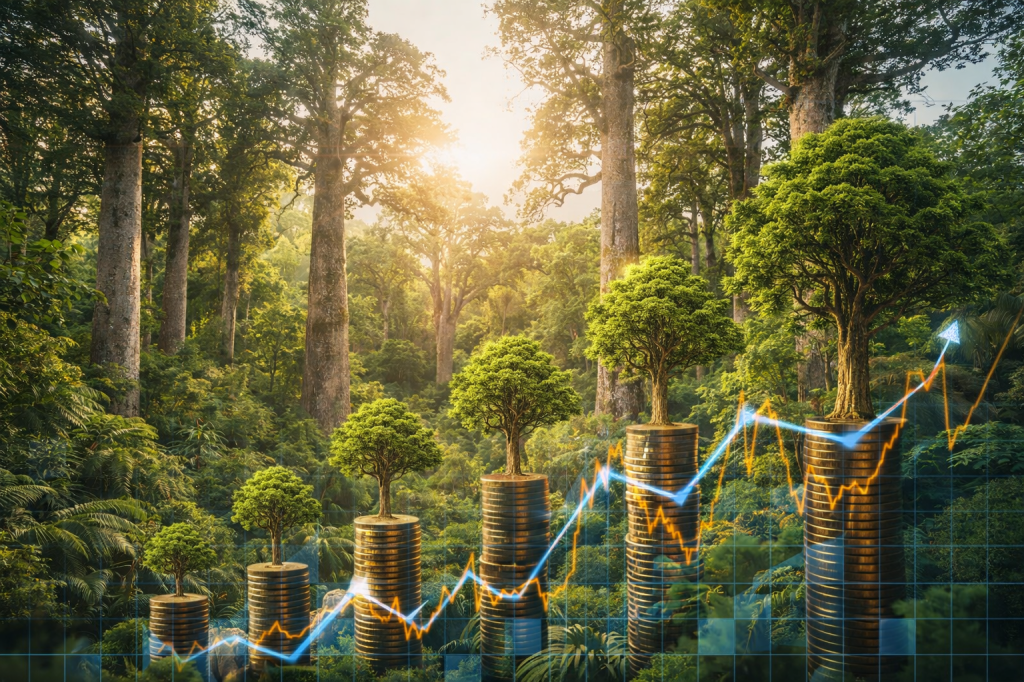
Above: We need a healthy environment for a healthy economy. (Image credit: ChatGPT)
A Te Tiriti and Democratic Issue
For Māori, this pattern is very familiar with (for example) the erosion of Māori authority over land and water. Environmental decision-making has long been subordinated to extractive economic priorities that have impacted tangata whenua. But what we are now witnessing is the erosion of institutional protections that safeguard everyone.
In this, we all face a common threat – one that reflects a broader global trend in which democratic institutions are formally preserved, but made functionally impotent — reorganised to facilitate economic throughput over public wellbeing.
When the consequences materialise — and they will — the burden will fall hardest and quickest on the most vulnerable. Whānau already struggling with rising costs of living and food prices, communities facing uninsurable homes due to forecasted climate chaos, regions like Te Tai Tokerau hit by infrastructure failure. Meanwhile, those who benefit from deregulated development settings are comparatively insulated — at least temporarily. What the elites fail to recognize is that ecological destabilisation is systemic. Ultimately, everyone will face long-term environmental instability that will spill over into the economy.
I’m not anti-development. Rather, I’m pro-decision making that is robust, backed by independent environmental scrutiny and constraint where necessary. That is how resilient economies are built. That is how democratic legitimacy is preserved. Instead, what the bill does is restricts environmental protection while opening up economic development with fewer and fewer limits.
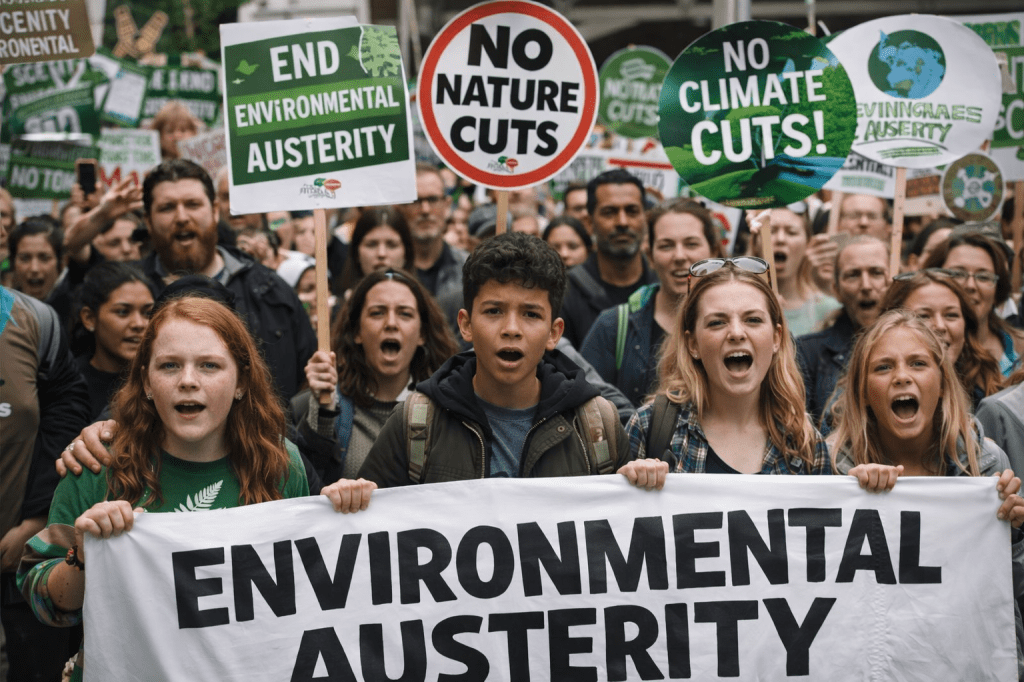
Above: Environmental austerity could easily give rise to public disenchantment. (Image credit: ChatGPT)
So What Now?
For a region actively working toward kai sovereignty, regenerative land use, and climate resilience, dismantling independent environmental oversight is more than a major disappointment. It’s extremely counterproductive.
I’d urge everyone to make your concerns about the Bill known to select committee, including the demand for the retention of a strong, independent environmental watchdog agency. And remind the government that they can’t keep eroding the fundamental conditions needed for ordinary people to live healthy lives. It would be a mistake to assume that the citizenry will without end tolerate the trespasses of its public servants. History is clear: governments that relentlessly push their populations further and further to the threshold of frustration and indignation will ultimately suffer the consequences.
The due date for interventions is 11 March 2026. But we can do more than just engage with a broken political system. We must strengthen regional and community-level resilience – especially in food systems, water security, land and ocean stewardship, and grassroots-led governance. Climate Action Tai Tokerau will continue working towards these aspirations, and we welcome you to join us.
(The views expressed are the author’s, and do not necessarily reflect those of Climate Ation Tai Tokerau)

 Climate Action Tai Tokerau