The two previous posts have focused on the human response to the climate crisis, including the work on high conflict by Amanda Ripley. What emerges for me is the absolute importance of understanding how we are complicit in the crises that are afflicting us.
Daniel Hoyer and his colleagues from the Crisis Database Programme have accumulated historical scholarship and used qualitative and quantitative methods to surface patterns in the crises that, in extreme examples, ended civilisations. You can read more about it here.
Extreme inequality as a common cause of collapse
One of the most common patterns that has jumped out is how extreme inequality shows up in nearly every case of major crisis. When big gaps exist between the haves and have-nots, not just in material wealth but also access to positions of power, this breeds frustration, dissent and turmoil.
Daniel Hoyer
Daniel Hoyer attributes extreme inequality as a pre-cursor to examples of societal collapse, echoing Amanda Ripley’s indentifying polarisation as a causal effect. And polarisation and income equality are on the rise. The OECD chart linked here shows the relative degree of income inequality in nations. Aotearoa is a little worse than Australia. Oxfam International in 2023 claimed that the richest 1% have accumulated nearly twice as much wealth as the rest of the world put together over the two previous years.
Understanding how the various faces of the polycrisis (or metacrisis) interact helps us makes sense of history, but also see the patterns of history recurring. This flow chart from a Royal Society article co-authored by Daniel Hoyer shows these interactions.
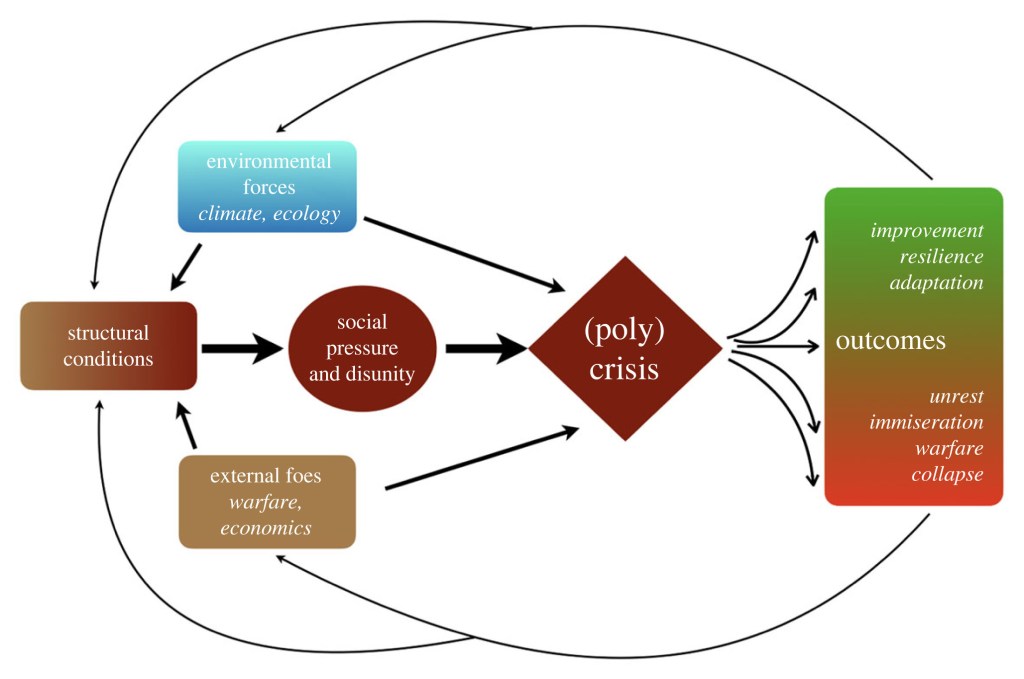
What is both ominous and encouraging about this is that the polycrisis can precipitate either beneficial or unfortunate outcomes. Daniel Hoyer provides historical examples of both outcomes.
On the left hand side of the diagram we see how environmental forces and social dynamics (external foes) can intensify the crisis.
Here is a recent video exporing these dynamics in more depth.
The Fourth Turning?
Neil Howe brings another perspective to this, proposing that history moves in seasonal cycles. He wrote about this in the late 20th Century, but illustrates it in this more recent video. His focus here is on America, but we can see similr dynamics playing out across the globe.
So what does this mean for the climate crisis?
Just three faces of the metacrisis (or polycrisis) are income inequality, social polarisation and the changing climate. There are many more related crises but for now we will just focus on these three. There is a direct relationship. Income equality increases because the already wealthy have the means to increase their wealth. Their ethical and moral failure to recognise their impact on others is most probably linked to their failure to recognise the impact of the extractive industries they are profiting from. These in turn are exacerbating the climate crisis. Simple examples are over-fishing, clearing forests, and mining fossil fuels. A socio-economic regime that creates dependence traps us as consumers of the system.
So surely the remedies are to be found in extracting ourselves from the web of consumerism and developing circular or more localised economies. Economies that build social cohesion rather than separate us and increase our wellbeing. If Neil Howe is correct, we can start to envisage those institutions that will see a more equitable distribution of wealth, build community cohesion, and heal the climate.
For me, a great place to start is in supporting the transition from the industrial food system to a regenerative food system. I am excited that the green shoots of regenerative food systems are happening here in Te Tai Tokerau and all over the globe.
A wider conversation?
To achieve any shift, we need to be able to see and recognise the green shoots and work more closely together to envision that what we are doing is creating fundamental change. Please leave a comment if you are interested in creating local forums to explore these themes more.

 Climate Action Tai Tokerau