Apparently we need a third supermarket chain to create more competition and reduce the price of food. While it might generate marginal savings, it is likely to have a net detrimental impact on the economy and people’s health.
In Australia, a 2024 Guardian article informs of a new report into supermarket power. The government-commissioned report identifies “a heavy imbalance in market power between suppliers and supermarkets in Australia’s heavily concentrated supermarket industry”. Heavy penalties for anti-competitive practices are anticipated if the report’s recommendations translate into statute.
Australia has four big supermarket chains – a quadopoly? How credible is adding another supermarket chain to our big players here?
Look at the banks as an example. We have four big Australian banks operating here, some with very un-Australian names. Their operations are very profitable here in times when a lot of families in Aotearoa are struggling with the cost of mortgages and rent.
Any new supermarket chain entrant that came into the market would probably need to be bigger than Woolworths to be able to stand up a nationwide operation and compete. They would have highly centralised supply lines that would inevitably increase the imports of food. So, for example, they would be sourcing their pork from Europe of the U.S. They would also favour large suppliers. The impacts would be greatest for regional economies.
They might also increase the consumption of highly processed foods, given their global supply chains leading to an increase in non-communicable diseases.
The Prime Minister spoke of exhausting all lines of enquiry on this issue. Before a new supermarket chain arrives on our shores, we need a full economic, social and environmental impact analysis. The food system is where we have the most agency to mitigate and adapt to climate change. The economic analysis needs to focus on backward and forward linkages in the supply chain.
Local regenerative food
Support for a transition from the current industrial food system to a regenerative food system will have multiple benefits explored elsewhere on this site (search for regenerative in our blog).
Unfortunately governments both red and blue, have developed food policy that perpetuate the industrial food system. A report by Sonya Cameron, published by the Kore Hiakai, Zero Hunger Collective, identifies five barriers to a more equitable food system.
- Supermarkets and corporates have dominated profit-driven industrial food systems, at the expense of local food economies (p. 13).
- Government has over-regulated ‘good’ food from small businesses and under-regulated ‘bad’ food from the corporate food industry (p. 14).
- Providing enough good food is difficult and stressful for time-poor families with high living costs participating in a low-wage economy (p.15).
- Poor food environments and busy lives also limit people’s ability to eat good food, leading to disconnection from food and poor health (p.16).
- The way our food systems are managed is having significant impacts on the environment, the climate, and the well-being of people (p17). (From Realising Food Secure Communities in Aotearoa)
Articulating the benefits of regenerative food systems would divert from the key ideas in this post. Here is a diagram from the Network for Business Sustainability summarising benefits of regenerative agriculture.
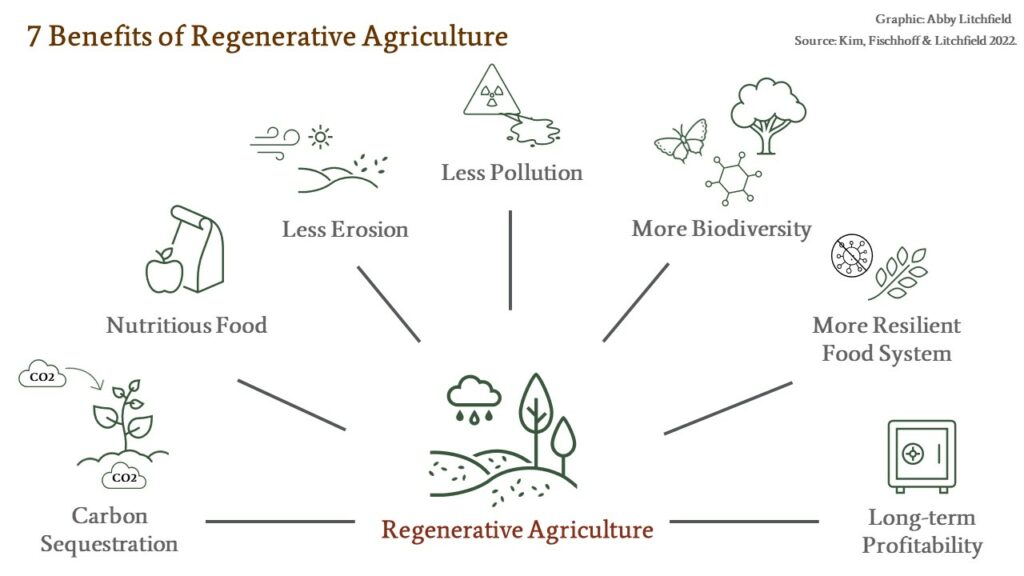
Just one point – a regenerative food system, in addition to regenerating the environment and procuring nutritious food, can regenerate communities.

 Climate Action Tai Tokerau