We have alternatives to gas.
- renewable generation options
- flexible demand pathways
- multiple transition strategies across sectors.
The magnitude of this issue is worthy of a much broader public debate.
Reducing gas demand also has a material impact on New Zealand’s emissions profile.
Based on current emissions factors, a reduction of 100 petajoules of gas consumption would lower gross greenhouse gas emissions by approximately 5 to 6 million tonnes of CO₂-e per year — around 7% of current national emissions.
This places gas transition decisions at the centre of New Zealand’s climate response.
A system changing faster than policy
New Zealand’s gas system is undergoing a structural shift.
Production has already fallen sharply, and forecasts indicate continued decline over the next few years. At the same time, estimates of remaining reserves have been revised downward.
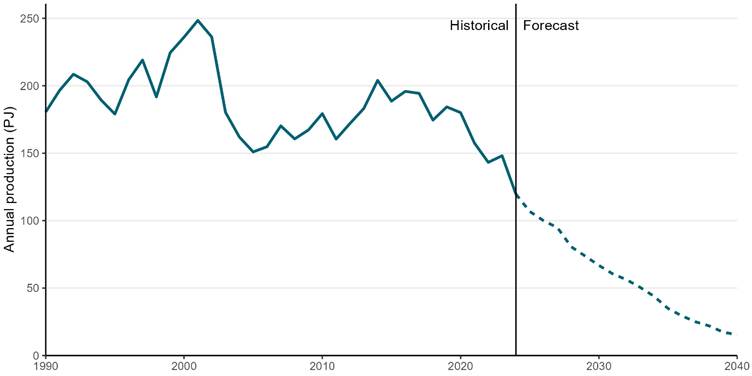
Gas net production (solid line) and forecast production (dashed line) based on production profile data. Image credit: MIBE
Gas supply constraints are not unique to New Zealand. Across OECD countries, they have driven significant changes in energy policy. In Europe, reduced reliance on Russian gas exposed the risks of dependence on imported fossil fuels. Prices rose sharply, prompting accelerated investment in renewable energy, efficiency, and alternative supply. In other countries, similar pressures have driven rapid growth in solar, wind, and energy storage.
The common lesson is clear: gas dependency exposes energy systems to global price volatility and geopolitical risk.
While prices can fall as markets adjust, they remain inherently uncertain. Countries that continue to rely heavily on gas remain exposed to these dynamics. Those that reduce dependence tend to gain greater control over long-term costs and system stability.
In Aotearoa we are at a choice point in how we respond to inevitable decline.
The LNG proposal in context
The proposal to import liquefied natural gas is often framed as a solution to this problem. But LNG is not simply a technical response. It is a strategic choice. It would:
- introduce long-lived fossil fuel infrastructure
- expose the system to global price volatility
- shift risk from domestic supply to international markets.
Most importantly, it avoids deciding how gas demand should change.
The missing step: demand-side strategy
Earlier in this series, we looked at how gas is used:
- Electricity generation
- Industrial heat
- Methanol production
- Residential use
- Fertiliser (urea)
Each of these has a credible transition pathway.
Some, particularly methanol, could be reduced relatively quickly without affecting essential domestic energy services.
The diagram below represents how the transition could work in the southern states of Australia. Four strategies together lead to a phase out of gas in residential buildings by the early 40s and reducing industrial consumption by 200 petajoules by 2045. We have less time, but we also have options.
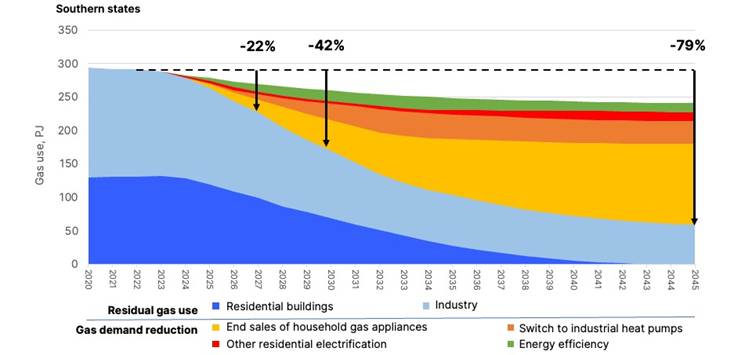
Total reductions achieved in southern states’ residential/industrial gas demand. From Reducing demand- abetter way to bridge the gas supply gap. IEEFA, Australia
A transition in Aotearoa could be based on a set of realistic scenarios:
- Rapid reduction in methanol production
- Gradual industrial electrification
- Household transition away from gas
- Reduced reliance on synthetic fertiliser
- Accelerated renewables installations.
Every credible pathway involves reducing gas demand. Importing LNG is the only pathway that avoids doing so.
What is driving current policy direction?
If the transition pathways are known, why are they not the primary focus? Energy policy does not develop in a vacuum. It reflects a combination of influences.
1. Risk management: There is a legitimate concern about supply shortages and dry-year electricity risks. This tends to favour solutions that appear reliable and immediate.
2. Economic and political pressures: Governments face cost-of-living concerns, regional employment considerations, and pressures to avoid disruption. These can favour continuity over transition.
3. Institutional inertia: Energy systems evolve slowly. Existing infrastructure, regulatory frameworks, and planning assumptions are often based on past conditions rather than emerging ones.
4. Industry influence: Like all sectors, the energy system includes stakeholders with a strong interest in outcomes. Established industries actively lobby, attempting to shape how problems and solutions are framed. This is a normal part of policymaking, but it can influence which options receive attention. Who are the voices the government is listening to?
A structural tension in the system
There is another feature of the system worth noting. The government plays multiple roles, as policymaker, regulator, infrastructure owner, and as a shareholder in electricity companies. For example, through its 51% stakes in Meridian, Mercury, and Genesis, the Crown receives hundreds of millions of dollars in dividends each year, depending on company performance and market conditions.
Returns from electricity generation are linked, in part, to market conditions, including periods of higher prices. This does not imply intent. But it does highlight how different incentives exist within the system. Some parts are designed for stability and reliability, while others operate within market dynamics where scarcity can increase returns.
The risk of misalignment
Taken together, these factors create a risk. Policy may be responding to a changing system, using assumptions from the system’s earlier context. This can lead to stranded assets – investments in infrastructure that may not be needed in the long term. This delays action and increases exposure to global price volatility
A different way to think about the transition
Our best response to the gas supply gap is to align planning with our aspirations for the future. We have a clear planning horizon now. Over the next five years, we can:
- reduce non-essential gas uses
- accelerate renewable generation
- electrify key sectors
- support households through transition
It is a challenge of alignment. Will current policy settings align us with the direction of the energy system, the risks we face, securing energy equity, achieving our climate commitments, and the opportunities available?
Or will we continue to default to 20th century conceptions?
Next in the series
A practical pathway for Aotearoa’s energy future →

 Climate Action Tai Tokerau