Why electricity prices are rising — and what Australia shows us
Electricity prices are one of the most immediate ways people experience the energy system.
In New Zealand, prices have tended to rise over time, with periodic spikes linked to fuel constraints and dry conditions. Recent increases have been closely associated with declining gas supply and higher costs for thermal generation.
By contrast, Australia provides a useful comparison.
A tale of two systems
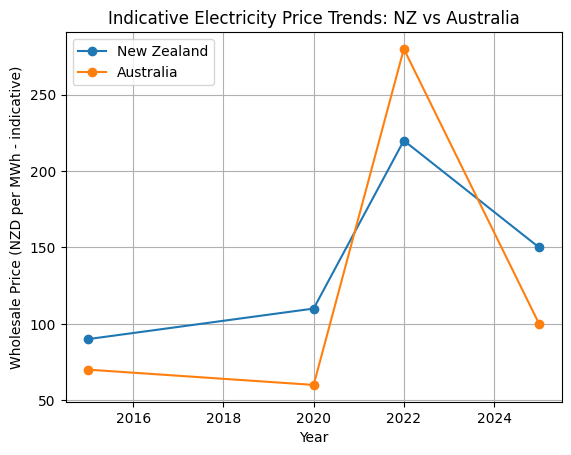
Over the past decade, Australia has invested heavily in solar and wind generation. This has had a clear effect on wholesale electricity prices. After sharp increases during the global energy crisis, prices have fallen significantly as renewable generation has increased. In simple terms: when more electricity is generated from low-cost renewable sources, the average price tends to fall.
New Zealand, by comparison, has seen a more gradual upward trend, driven partially by continued exposure to fuel constraints, coupled with less downward pressure from new low-cost generation.
What Australia gets right
Australia demonstrates something important. Solar and wind generation reduce daytime prices. Over time, this lowers wholesale electricity costs.
This aligns with a simple principle: Once built, renewable generation has very low operating costs – and that flows through to prices. Australia is also growing battery storage to manage short-term variability.
What Australia gets wrong (or hasn’t solved yet)
The Australian experience also highlights a critical issue: The benefits of cheaper generation are not shared evenly. Wealthier households with rooftop solar have significantly lower bills. But renters and low-income households have limited access to these benefits
At the same time Australia’s vast geography requires major transmission investment. These costs are passed through to consumers
New Zealand is in a different, and in many ways stronger position. We have a high share of renewable generation, a more compact transmission system, and strong potential for distributed solar. We don’t face the same scale of transmission challenge.
That means we can capture the benefits of renewables without some of the structural disadvantages Australia faces. Yet our power is more expensive.
The real issues: price stability and energy equity
The key issue is not just price level, but price stability. In New Zealand, gas constraints increase price volatility, and dry years amplify that volatility. In contrast, the growing solar and wind power production, combined with hydro storage, created a more stable pricing environment.
However, there is a real risk. If the transition is left to the market alone inequity will increase. Australia is already showing this pattern. Cheaper energy is possible, but not automatically fair. In later posts we will explore provisions such as the Ratepayer Assistance Scheme to embed equity in system design.
What this means
Australia shows that renewable energy can reduce electricity prices. It also shows that
- system design matters
- equity matters
- infrastructure planning matters
New Zealand has a chance to learn from both the strengths and the shortcomings of that experience.
Our challenge is to design the system so those benefits are widely shared.
Cover image: In 2024, a transmission tower near Glorit toppled during routine maintenance, cutting power to the entire Northland region – a strong reminder of the need for locally distributed power grids. Image credit Radio NZ and Kawakawa Electrical
Read the full report here.
Sign the Greenpeace petition.
Next in the series
A practical pathway for Aotearoa’s energy future

 Climate Action Tai Tokerau