The new coalition government has moved to undo some good climate policy and take Aotearoa back to the past. These policy moves are:
- Scrapping the Clean Car Discount
- Raising speed limits
- Stopping cycling and walking infrastructure developments
- Removing or reducing environmental protections
- Winding back progress on policy diversity (mātauranga Māori).
These policies will hamper our climate response and have other negative consequences.
Scrapping the Clean Car Discount
The Clean Car Discount (CCD) was an elegant instrument to incentivise people to choose low emissions options. This chart shows the gradient between zero emissions and high emissions vehicles in the scheme’s 2022 version. From a government perspective it had the potential to be a cost-neutral incentive.
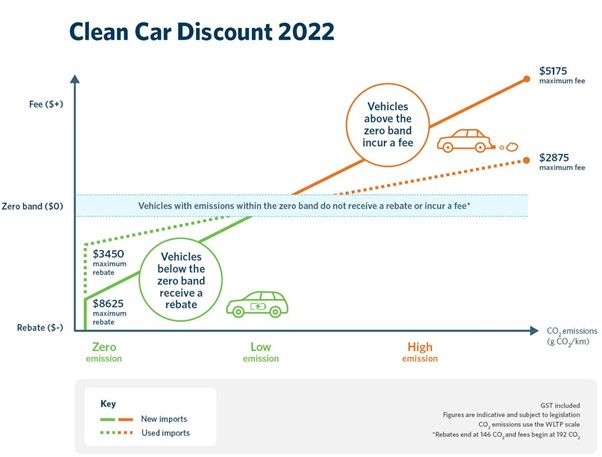
Research from Drive Electric claims “the new Government’s policy to remove the Clean Car Discount (CCD) and weaken the Clean Car Standard could mean between 100,000 and 350,000 fewer electric cars on New Zealand roads by 2030, and increasing emissions by between 900 and 3,000 kilotonnes. It could also increase costs to the economy by between $900m and $3.5b, mainly from importing more fossil fuel.”
The health costs of air pollution from vehicles is estimated at $10.5 billion a year.
The CCD was criticised as a ute tax. We are facing an existential threat. Rather than whinge about having to pay extra for a new ute, perhaps buying a second-hand ute is another option until more electric utes come on stream. In the past, when we faced crises such as the world wars, people collectively made sacrifices.
Raising speed limits
According to Simeon Brown, “our coalition Government wants to see a transport system that boosts productivity and economic growth and allows New Zealanders to get to where they want to go, faster and safer.” Mmm – faster and safer.
The previous government reduced speed limits in an attempt to reduce the road toll. Waka Kotahi estimates it has reduced speed limits on four percent of the nation’s roads. Local examples are the Brynderwyns and Dome Valley – the latter has been the scene of several road deaths.
Waka Kotahi estimates that increasing speeds from 80 to 100 kph will increase emissions by five to ten percent. The decision to increase speeds is a naked example of the prioritising of the economy over environmental and social benefits. But according to Emeritus Professor Ralph Simms “Dropping the maximum speed by 10 kilometres per hour only makes two to four minutes difference over 100 kilometres”.
There is a clear relationship between increased speed and the degree of harm caused in accidents. Note the increase in the probability of death rising from a head-on collision rises from about 30% at 80 kph to 90% at 100 kph.

Figure 1: Corben (2011) illustrates these tolerances for collisions with pedestrians, and for side-on collisions and for head-on collisions. From Economic evaluation of the impact of safe speeds: literature review November 2012
If it were my decision, we would have a maximum speed limit of 80 kph on all roads. It would provide an immediate reduction in emissions and a range of other benefits. But the high priests of economic progress want to squeeze the last drops of efficiency from the planet’s resources with no apparent concern for the future.
Stopping cycling and walking infrastructure developments
The previous government had a plan to reduce VTK (vehicle kilometres travelled) by light vehicles by 20% by 2035.
The VKT targets were designed to reduce carbon emissions by 13.4 million tonnes by 2035, helping Aotearoa-NZ towards meeting its Paris target agreements and avoiding up to $23 billion of overseas emissions credits spending by taxpayers.
(Bernard Hickey, The Kaka)
Simeon Brown, the new Minister of Transport has issued instructions to regional councils to immediately stop cycling and walking projects paid for by the Climate Emergency Response Fund. The Minister says “my priority in transport is to build and maintain the roading network so that we can have a safe, efficient and productive transport network which helps Kiwis get where they need to go, quickly and safely.” (Newshub)
Removing or reducing environmental protections
There is a clear link between biodiversity, thriving ecosystems and climate healing. The Coalition Government has already repealed the Natural and Built Environments Act, that was designed to update the Resource Management Act. Here is National’s Chris Bishop from the Hansard Record of the parliamentary debate.
The other thing that we are unpicking and doing away with is the subordination of everything to the protection of the natural environment. Our view, on the Government benches, is that the balance in the NBA was wrong. We canvassed, at length, during the first reading and second reading of the NBA in the last Parliament, exactly the problems with that. Look, reasonable people would disagree on that balance. But we took to the election proposal to repeal these Acts by Christmas, and we are doing so. (Bolded text is my emphasis)
Our current policy regime has insufficient protection for the environment. Further erosion of environmental protections will cause further declines in biodiversity, and ecosystem and climate health.
Winding back progress on policy diversity (mātauranga Māori)
Unfortunately, attacking Māori remains a way to get votes. Already there have been moves to use English names before Māori names for government institutions and moves to dismantle the Māori Health Authority. Professor Margaret Mutu (Ngāti Kahu, Te Rarawa and Ngāti Whātua) comments.
The agreement the parties have made is in breach of so many international laws, but it’s also just in breach of common humanity. I hope that people understand the magnitude of what they’re doing. They’re stripping us of fundamental human rights that we’ve struggled over the past 50 years to take small steps towards.
The intention to dismantle Te Mana o Te Wai is troubling. It is covered here in some detail as the inclusion of the principles in Te Mana o te Wai was an encouraging example of how mātauranga Māori can be an effective antidote to the excesses of Western materialism.
The National Policy Statement for Freshwater Management 2020 (NPS-FM) sets out the objectives and policies for freshwater management under the Resource Management Act 1991.
The NPS-FM came into effect on 3 September 2020 and replaced the National Policy Statement for Freshwater Management 2014 (amended 2017). (from Ministry for the Environment)
The document National Policy Statement for Freshwater Management can be downloaded here. It presents te Mana o te Wai as a “fundamental concept”.
NPS-FM Clause 1.3: Fundamental concept – Te Mana o te Wai
Concept
1. Te Mana o te Wai is a concept that refers to the fundamental importance of water and recognises that protecting the health of freshwater protects the health and well-being of the wider environment. It protects the mauri of the wai. Te Mana o te Wai is about restoring and preserving the balance between the water, the wider environment, and the community.
2. Te Mana o te Wai is relevant to all freshwater management and not just to the specific aspects of freshwater management referred to in this National Policy Statement.
Framework
4. The 6 principles are:
- Mana whakahaere: the power, authority, and obligations of tangata whenua to make decisions that maintain, protect, and sustain the health and well-being of, and their relationship with, freshwater.
- Kaitiakitanga: the obligations of tangata whenua to preserve, restore, enhance, and sustainably use freshwater for the benefit of present and future generations.
- Manaakitanga: the process by which tangata whenua show respect, generosity, and care for freshwater and for others
- Governance: the responsibility of those with authority for making decisions about freshwater to do so in a way that prioritises the health and well-being of freshwater now and into the future
- Stewardship: the obligations of all New Zealanders to manage freshwater in a way that ensures it sustains present and future generations
- Care and respect: the responsibility of all New Zealanders to care for freshwater in providing for the health of the nation.
5. There is a hierarchy of obligations in Te Mana o te Wai that prioritises:
- first, the health and well-being of water bodies and freshwater ecosystems
- second, the health needs of people (such as drinking water)
- third, the ability of people and communities to provide for their social, economic, and cultural well-being, now and in the future
Bullet point 5 especially reveals underlying assumptions in tune with mātauranga Māori. The “health and well-being of water bodies and freshwater ecosystems” are valued in their own right and positioned at the top of the hierarchy. Economic values are presented as a well-being alongside social and cultural well-being.
During the election campaign the Act Party stated its intention to remove Te Mana o Te Wai labelling it a “political rather than a pragmatic approach to consenting”. Māori leaders and scientists objected but the government has confirmed that the National Freshwater Statement for Freshwater Management will be replaced in a process that will take 18 to 24 months. The new Chair of the Northland Regional Council supports the government’s approach. Economics and the profit motive are returned to the top of the values hierarchy.
Otto Scharmer likens the body of the orthodoxy acting like the immune system in a human body. When it sees something foreign, it moves to protect the system against it. The removal of Te Mana o te Wai is a significant backward step. We know of the importance of the hydrological cycle in cooling the planet. Healthy waterways and replenished aquifers support a healthy climate.
Fortunately governments come and go. So the presence of a government hostile to the environment should be a call to action to find those ways independent of policy to heal the climate. It also calls on us to have a more inclusive approach to climate action and community building, as even the relatively mild climate policies initiated by the last government have induced a backlash that has delivered the current government. It is said that we get the government we deserve. I would have thought that Cyclone Gabrielle was enough of a wake-up call to shift public attitudes about climate change, but apparently not. What will it take?

 Climate Action Tai Tokerau
It will most likely take a direct threat to life, health and/or wealth for a majority of us. Four years ago, when an unknown disease threatened us directly, and we feared to get seriously ill or even die, we supported bold and swift action, and for a brief period we were open to new ideas and “building back better”, before we relapsed into “bouncing back harder”.
We respond much more to extrinsic messaging that triggers fear in us. That’s why a majority of us responded to a campaign of “more for you – less for everybody else”, claims that crime is rampant, misinformation that public spending and debt are out of control etc. The weather bombs didn’t affect enough of us to trigger a collective reaction, and we’re only too keen to write them off as one-off events and forget about them over a nice summer. The threat of losing the roof over our heads to a future cyclone, or our home to a future flood, or our lives to a future heatwave, are not tangible enough, compared to the gang member living down the road, or the block of cheese costing 50% more than two years ago. We are conditioned to react to immediate and imminent threats, not something that will eventuate at some point in the near future.
As for the new people in power at the central and regional government levels, we don’t have to engage with the Coalition of Cruelty and the Farmers of Frustration. On social media, trolls are best ignored and never responded to. Engaging with them will only give them oxygen, drive more attention to them and amplify their messages, as if there was still something left to debate or worthy about their cause. We can still make a lot of progress locally and regionally, by doing what we now know needs doing. We have all the solutions we’ll ever need.
LikeLike