This is the fourth post in our Energy Future Series.
The debate about LNG often assumes a single question: If we don’t import gas, what replaces it? But this is the wrong way to think about the problem. Natural gas is not used for a single purpose. It supports multiple parts of the economy, each with different functions and different transition options.
There is no single replacement for gas. There are multiple transition pathways, each addressing a single use.
Where gas is used today
Natural gas in Aotearoa is used across five main areas:
- Electricity generation (including peaking)
- Industrial process heat
- Methanol production (export-focused)
- Residential and commercial heating/cooking
- Fertiliser production (urea)
Here is an approximate breakdown:
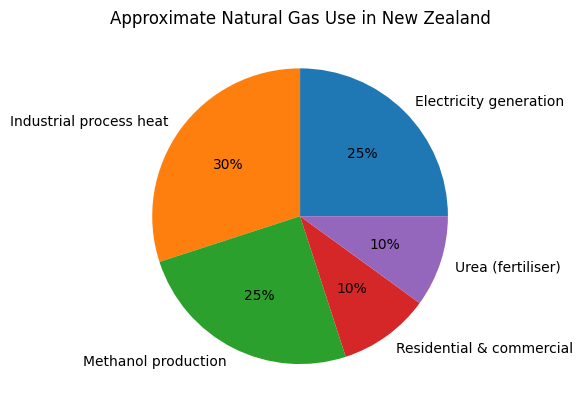
This chart shows that gas is not dominated by electricity use alone. It is spread across multiple sectors. That means the transition away from gas is not a single decision, but a coordinated set of changes. Each use can be addressed differently.
Transition Pathways
1. Electricity generation (~ 25%)
| Current role: Peaking and backup Dry-year support | Transition: Solar + hydro (preserve storage) Wind (complements winter demand) Batteries (short-term peaks) Demand response |
Gas is used because the system lacks flexibility, not because alternatives aren’t available.
2. Industrial process heat (~30%)
| Current role: Food processing Timber, pulp, manufacturing | Transition: Electrification (heat pumps, electric boilers) Biomass (wood waste, residues) Efficiency improvements |
This is one of the most practical and already underway transitions.
3. Methanol production (~25%)
| Current role: Large-scale industrial use Primarily export-focused | Transition options: Scale down as gas declines Shift to green methanol (longer term) Reallocate gas to higher-value domestic uses during transition |
Methanol is produced mainly for export, using about 25% of our natural gas. It is primarily used as a feedstock for chemicals such as plastics, resins, and industrial materials. In strong production years, methanol exports have been worth on the order of $1 to 2 billion annually.
This raises an important question. Should a limited domestic gas resource be used to produce export chemicals, or prioritised for domestic energy security during the transition? This is not an essential domestic energy use – it is an industrial export choice.
4. Residential & commercial (≈10%)
| Current role: Space heating Water heating Cooking | Transition: Heat pumps Electric hot water systems Induction cooking |
One of the real barriers to moving away from gas is cost at the household level. Disconnecting is not simply a matter of turning off the supply. It often requires replacing appliances, upgrading electrical systems, and paying disconnection fees. These costs are typically borne upfront, even when the long-term savings are positive.
At the same time, gas networks have high fixed costs. As fewer households use them, those costs are spread across a shrinking customer base, increasing prices for those who remain.
This creates a paradox: the system becomes more expensive as people begin to leave it. This transition needs government support, or a structured exit, suburb by suburb, funded perhaps as an electricity levy. or via a mechanism such as a ratepayer assistance scheme. We begin with suburbs with an underused gas network. Without coordinated planning, the transition risks being slower, more expensive, and less equitable.
Most of the appliances used to replace gas, such as heat pumps and electric hot water systems, are manufactured overseas. New Zealand does not currently produce these at scale. However, this does not mean the transition simply replaces one form of import with another.
Gas must be imported (or extracted) and paid for every year. Electrical appliances are typically purchased once and last for many years, enabling the use of locally generated energy.
The shift is not from imports to no imports, it is from ongoing fuel dependency to one-off investment in infrastructure. At the same time, installation, maintenance, and system integration create local jobs and economic activity.
5. Urea / fertiliser (~10%)
| Current role: Gas used as feedstock for nitrogen fertiliser. | Transition: Reduced reliance on urea More efficient nitrogen use Regenerative farming systems Alternative inputs and practices |
The use of urea fertiliser is closely linked to natural gas, which is used both as a feedstock and energy source in its production.
While urea can increase pasture growth, a significant proportion of the nitrogen applied is not taken up by plants. Instead, it can be lost to the environment through leaching, runoff, and emissions.
This contributes to:
- nitrate pollution in waterways
- degradation of freshwater ecosystems
- emissions of nitrous oxide – a potent greenhouse gas.
In some systems, high nitrogen inputs can also create imbalances in pasture and livestock nutrition, increasing management challenges and reducing overall system efficiency. A growing cohort of farmers using regenerative practices are proving that synthetic nitrogen applications can be significantly reduced or eliminated.
This highlights an important point: reducing reliance on urea is not only an energy transition. It is also part of improving environmental outcomes and farm system resilience.
It is difficult to justify billion-dollar LNG infrastructure to support a product that can be imported via existing ports and whose demand is likely to decline over time.
What this means
When broken down, even basic analysis reveals that no single use requires LNG. Each has a credible transition pathway with many already underway.
Instead of replacing gas with more gas we can:
- reduce demand where possible
- substitute with local resources
- redesign systems over time
What is needed now are detailed transition plans to move from a system based on extraction, import costs, and volatility, to one based on local resources, flexibility, and long-term resilience.
Next in the series
Why electricity prices are rising — and how to stabilise them

 Climate Action Tai Tokerau
He rawe! Transition Engineering IS one of the most important jobs for us in the North! Inge
LikeLike