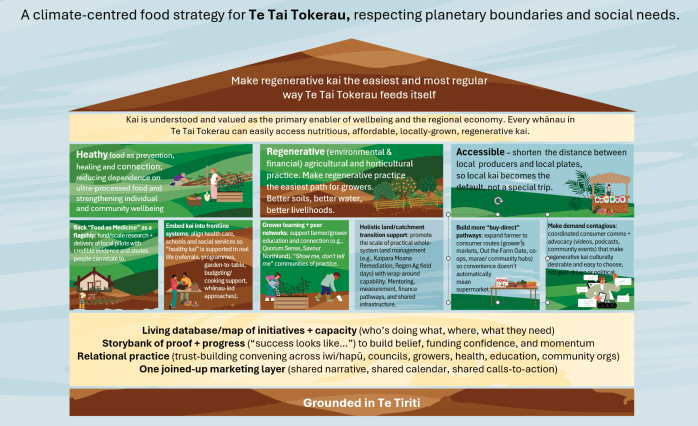
What do you think of our food system strategy?

In 2025 we published Repairing Our Food Web: Accelerating the transition from Industrial Food Systems to Regenerative Food Systems in Te Tai Tokerau, and a shorter graphical summary. The food system is complex, so it is hard to summarise, but we have now condensed it further into a one-page diagram.  (Click on the image for … Continue reading What do you think of our food system strategy?
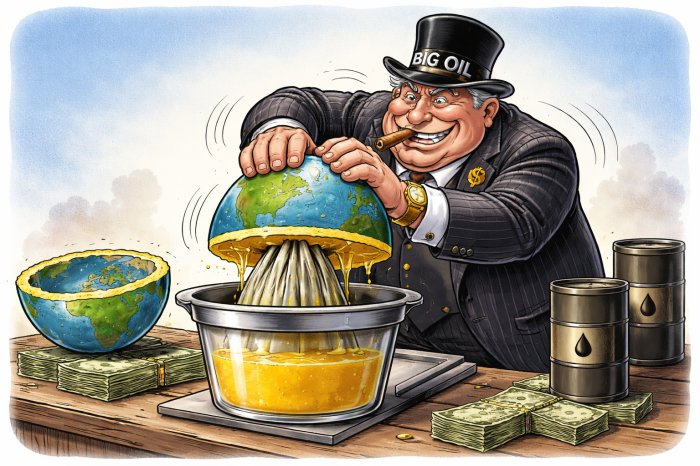
A port for the past — a call to stop the LNG terminal

The New Zealand government’s decision to build a port for gas imports feels designed for a world with a 1999 use-by date. Only those financially invested in preserving the extractive economy of the twentieth century, or those who have swallowed its kool-aid, persist with the fantasy that that world can continue. It is clear that … Continue reading A port for the past — a call to stop the LNG terminal

Why the Way We Feed Our Kids Matters for Climate and Community

Every day across Northland, thousands of students sit down to a free lunch. What’s on the plate tells a much bigger story about who we are and who we could become. Approximately 120 schools get lunches via the Ministry of Education’s Kai Ora, Kai Ako programme. Of these 53 schools manage their own lunches, 54 … Continue reading Why the Way We Feed Our Kids Matters for Climate and Community

From consumers to citizens

I was born in 1956, a year after Victor Lebow proclaimed the gospel of consumption. Our enormously productive economy demands that we make consumption our way of life, that we convert the buying and use of goods into rituals, that we seek our spiritual satisfaction, our ego satisfaction, in consumption.… We need things consumed, burned … Continue reading From consumers to citizens

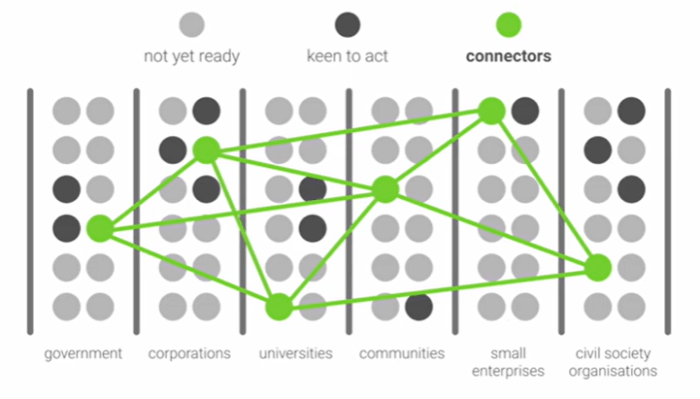
Working the local-global nexus

Nations' governments are unreliable actors for climate action. As politics becomes more polarised, we can expect shorter parliamentary terms and greater swings in policy focus. Cities and regions are doing much better, with organisations such as the C40 leading the way. The C40 now includes 97 cities representing 22% of the global economy. The current … Continue reading Working the local-global nexus